Sunday, April 11, 2010

Favorite Films: The 1990's

This following group of posts will not be as extensive in categories, or analysis as the Decade in Review post was for 2000-2009; it will however give a breakdown of some of my favorite films of the decade between 1990-1999. Contrary to the previous post, I will limit these posts to 10 films per decade, I will not try to limit it to the five or six I had previously said. I will, however, try to give one favorite film with some analysis followed by nine to ten other films in alphabetical order.

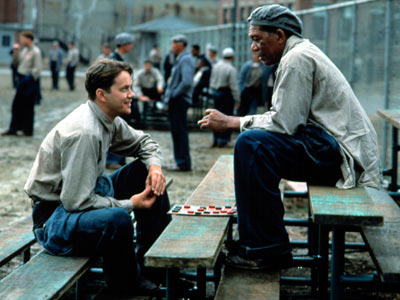
1. Shawshank Redemption (1994) Frank Darabont - In 1994 a young filmmaker took two of the great American actors to an out-of-commision prison in Mansfield, Ohio with a script based off of an uncharacteristic novella by the king of horror, Stephen King. The novella was "Rita Hayworth and the Shawshank Redemption." The story follows a man convicted with the murder of his wife and how he stays positive through the crucible and brings life back to the institutionalized men. The film condenses some of the novella's characters, specifically, the warden, who remains the same man throughout the film and is three men in the novella. The protagonist is played by an inspired Tim Robbins fresh off of two brilliant collaborations with American master, Robert Altman, and a successful political satire of his own, Bob Roberts. Robbins is perfect through the film, but the heart of the film comes from Morgan Freeman, the man Pauline Kael said was the greatest working American actor: after his first picture. The films tells a story of unlikely friendship through trying circumstances and 20 years of rejections, new friends, and old friends dying off. Darabont's film is a beautiful film that captures the best of friendship in the worst of circumstances.

The Rest:

Being John Malkavich (1999) Spike Jonze
Bringing Out the Dead (1999) Martin Scorsese
Fargo (1996) Joel Coen
Goodfellas (1990) Martin Scorsese
L. A. Confidential (1997) Curtis Hanson
Magnolia (1999) Paul Thomas Anderson
The Player (1992) Robert Altman
Pulp Fiction (1994) Quentin Tarantino
Saving Private Ryan (1998) Steven Spielberg
Three Colors Trilogy (1993-94) Krzysztof Kieslowski

Tuesday, April 6, 2010

A Decade in Review

I did make a Best of the Decade list which I will post here. I will also be unveiling a new style list that I was just introduced to where I will give a favorite film of each decade, and then I will give a few (up to five) honorable mentions (in alphabetical order) for that decade. This is in order to forego a traditional top whatever movie list which forces me to say "this is my 3rd favorite movie of all time." That will be posted within the next few days, but here are the Top 10 of 2000-2009 in a semi-organized fashion.

10. Up in the Air (2009) by Jason Reitman - Reitman made three films in the latter half of the last decade that were all great films in one way or another, Thank You for Smoking made a contemptible man into a lovable protagonist, Juno showed the hardships of being a 16 year, especially one who becomes unexpectedly pregnant, but his latest film was the one that was completely relevant, and pulled out the tough stops to say something important. Up in the Air is a romantic comedy that refuses to play by any preset standards, shows the American dream at its worst, is driven by a great screenplay with powerhouse performances by its three principles, including the best performance of George Clooney's already stellar resume.

9. There Will be Blood (2007) Paul Thomas Anderson - Along with Reitman, Anderson is a young auteur that will be making powerful and relevant films for years to come. His fifth feature breaks down the standard dichotomy that has faced America since its inception: Faith versus Greed. How much is too much? How far is too far? Daniel Day-Lewis plays Daniel Plainview in this throw back to a 1970s style Western and is the supernatural force behind this powerhouse film that toes the fine line between melodrama and hysteria, but toes it with dignity and class and never misses a step.

8. The Departed (2006) Martin Scorsese - The last decade was a good one for my favorite director. While he didn't have an all-time great, such as Goodfellas, Raging Bull or Taxi Driver he had three films that were very good, and capped it in 2006 with this great film that, perhaps, just missed the pantheon, but did finally win him his long overdue Oscar. The film's plot is Shakespearean and takes its viewers on a twisting turning ride through Boston's Irish underworld. With a great ensemble cast, Scorsese makes his return to the streets a big one in this Crime Thriller that is bound to be a classic.

7. The Assassination of Jesse James by the Coward Robert Ford (2007) Andrew Dominik - 2007 brought back the Western in a big way. A genre that I thought was officially dead when Clint Eastwood made the beautiful Unforgiven 15 years earlier in 1992. But not everything is officially dead after their soliloquy is written, and if one doesn't count a film I have further up the list as a Western, The Assassination of Jesse James is the best Western made since '92. Photographed by the oft-underappreciated Roger Deakins, the film is beautiful to look at from start to finish, and as some critics pointed out the title allows us to not worry about the ending of the film and just see how it all unfolds. Maybe this soliloquy is the true swan song, but something tells me the Western will never actually die in American cinema, its too important to our nation's mythos.

6. Adaptation (2002) Spike Jonze - In 1999 the world was introduced to a young screenwriter and a young director and the world of cinema would never be the same. The film, Being John Malkavich, the screenwriter: Charlie Kaufman, the director: Spike Jonze. In 2002 the two men joined forces once again to create another gem, Adaptation. The film follows Charlie and his fictional twin Donald as they try to adapt The Orchid Thief into a screenplay. The twins are played by Nicolas Cage, in his best performance since Leaving Los Vegas in an implosive performance that rivals Day-Lewis in There Will be Blood and Sean Penn in Mystic River.

5. Munich (2005) Steven Spielberg - Some films are important because of artistry, some because of message, some just are, and some have all three. In 1972 the Israeli Olympic team suffered a terrorist attack by a group of Palestinian nationalists called Black September, Mossad retaliated by sending a secret team of intelligence experts out to dispatch of these men. Spielberg's 2005 masterpiece follows the retaliation in a thriller for the ages, but when he leaves us with the last shot of the picture, we get it. This is one of those films that is important for its artistry, its message and for various inexplicable but noticeable reasons.

4. Synecdoche, New York (2008) Charlie Kaufman - Here's that name again. Charlie Kaufman made the list for his directorial debut by being the king of a fairly weak year. As I stated in a post just a few days ago, this may be the most profound film that I have ever seen, as a screenplay its perfect, the Magnum Opus of Hollywood's best writer. As an acting piece it is top notch, from a spiritual and philosophical level it is near the peak. Philip Seymour Hoffman is pathetic as Caden and we cannot help but see ourselves at our worst in him. He just wants to be remembered. Well, he will be, and so will this film.

3. Mystic River (2003) Clint Eastwood - If someone were to tell Dirty Harry that he was going to have a second career even better than his first, but it wouldn't be for being rough and tumbled but a true artist, they should be found and put on a mantle. By 2003, Clint Eastwood had already won two Oscars for Unforgiven, but then it turned out, it was no fluke and 2003's Mystic River marked the beginning of what has to be an unparalleled string of pearls for a director in his 70s making seven films in seven years all of which have been lauded in most film circles. Sean Penn gives one of the best performances of the decade and is flanked by one of the best ensembles of the decade.

2. No Country for Old Men (2007) Joel and Ethan Coen - These brothers have made a career of making films that eat at their audience from start to finish. This is their masterpiece. This is the best film of the best year of the decade. A cat-and-mouse thriller that pits an everyman against a man that could be the Grim Reaper himself, though I doubt it. Maybe Death's first general though. Playing the best villain since Hannibal Lector, Javier Bardem steals the show as Anton Chigurh a sadistic and mysterious man that seems to have no stakes in his business other than the love of seeing other people loose his game.

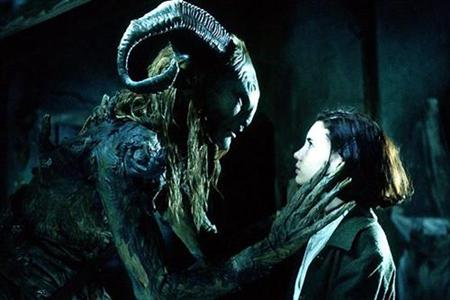
1. Pan's Labyrinth (2006) Guillermo del Toro - Once ever 15 - 20 years an explosion of talent enters Hollywood from a foreign language market. In the 50s and 60s it was a massive European explosion with the French New Wave, the Italian Neo-realists and Ingmar Bergman from Sweden. This is probably the longest stretch of American love for foreign cinema ever as it stretched into the 70s and early 80s as Bergman pumped out masterpiece after masterpiece. In the early parts of the last decades there was some smoke coming out of Mexico, but in 2006 the fires erupted as the top three directors from Mexico (lovingly dubbed the Three Amigos as they are friends and business partners) as del Toro, Cuaron and Inarritu all pumped out critically acclaimed films. Pan's Labyrinth was the best of them, also the only one made strictly in Spanish. The story has been called a Fairy Tale for adults and must be seen to be appreciated, as a plot description would not suffice.

Honorable Mentions - Lost in Translation (2003) Sofia Coppla, Eternal Sunshine of the Spotless Mind (2004) Michel Gondry, Juno (2007) Jason Reitman, Million Dollar Baby (2004) Clint Eastwood, Lord of the Rings (2001-03) Peter Jackson, Iwo Jima Saga (2006) Clint Eastwood

Best Year - 2007
Screenwriter of the Decade - Charlie Kaufman
Director of the Decade - Clint Eastwood
New Artist - Jason Reitman
Actor (not performance) - Sean Penn
Actress - Kate Winslet
Lead Male Performance - Daniel Day-Lewis (There Will be Blood) Sean Penn (Mystic River) tie
Lead Female Performance - Kate Winslet (Eternal Sunshine of the Spotless Mind)
Supporting Performances - Javier Bardem (No Country for Old Men) Naomi Watts (21 Grams)
Original Screenplay - Synecdoche, New York - Charlie Kaufman; Eternal Sunshine of the Spotless Mind - Charlie Kaufman; Pan's Labyrinth - Guillermo del Toro
Adapted Screenplay - No Country for Old Men - Joel and Ethan Coen; Adaptation - Charlie Kaufman; Up in the Air - Jason Reitman and Sheldon Turner
Thursday, April 1, 2010

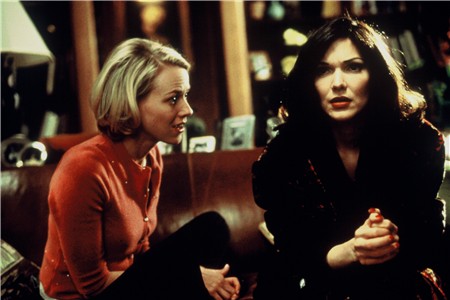
Mulholland Drive (2001) by David Lynch

David Lynch's dark, experimental film noir, Mulholland Drive, is a mind screw of the highest quality. The film has several explanations, the question, however, is whether trying to explain this film is even necessary. I, for one, don't believe it is.

Mulholland Drive is a dark, sexy and thrilling film that keeps you wondering what the mystery is from start to finish and leaves you wondering if there is even an explanation to be had once it is over. Watch it.

Friday, March 26, 2010

Synecdoche, New York (2008) by Charlie Kaufman

In 2008 screenwriter, Charlie Kaufman, perhaps the most creative and original screenwriter currently working, made his directorial debut and, what a debut it was. Synecdoche, New York is, perhaps, the most profound film that I have ever seen exploring the nature of love, lust, life, death, art and the meaning of all of it, whether art imitates life, or life is art, or any other combination of "art" and "life" that I can put together on the fly. On the surface the film follows Caden Cotard (Phillip Seymour Hoffman) through his life from 40 - 80 (or 90 depending on whether you believe Hoffman's interview or the makeup artists) as he receives a McArthur grant and tries to make a piece of art that will define his life at the same time that it captures everyone's story.

The surface, however, is rarely what we're concerned with. The story gets at many deep ironies and intricacies of life. Whether its Sammy, the man who lives his life following Caden, knowing him more than Caden knows himself, or that Caden loves Hazel through the whole story, but spends his whole life desiring the woman or women that he's not with in at the moment, whether it be Adele (Catherine Keener), Claire (Michelle Williams) or even Hazel. Hazel's desire for Caden takes on more dangerous imagery, she lives in a house that is always on fire, a slow smoldering that never goes out and never consumes; it just slowly burns forever until she finally gets what she wants and the turn that it takes.

The film, which Roger Ebert named the best film of the last decade, is hard to describe properly without spoiling it for anyone who has not seen the film, or without having a proper dialogue, so I'll cut the review off here, but know that it is a labyrinth of emotions and ideas. Charlie Kaufman (writer of the wonderful Being John Malkovich, Adaptation, and Eternal Sunshine of the Spotless Mind) writes another gem, and gets to put a very personal stamp on it as his first film at the helm. Watch this film more than once, the more you watch it, the more you'll be able to get out of it.

Wednesday, March 24, 2010

Alexander Nevsky (1938) by Sergei Eisenstein

1938 was a rough year for Europe. In represents the peak of the pre-war Nazi scare. A time between the Soviet-Zazi non-aggression pact and the Nazi invasion of Poland. Soviet Premiere, Josef Stalin, did not truly trust the Nazi's and he wanted the people of the Soviet Union to beware that there was a chance that the uneasy peace could be broken at anytime. Stalin turned toward his go-to filmmaker, Sergei Eisenstein, perhaps best known for his silent, Pro-Communist propaganda piece, Battleship Potemkin. This time Eisenstein takes on a less contemporary subject.

Alexander Nevsky was a grand prince in Medeval Rus, and has become a folk hero to the Russian people as a uniter of the Russian people as he helped them stand against the Swedes, Mongols and, in the case of April 5, 1592--The Germans. Which is the battle that is at the center of this picture. Eisenstein's film captures the highs and lows of warfare, and does a great job of propagandizing the historical scenarios to make them both fairly accurate and relevant to the situation at hand in the Soviet Union in 1938.

In 2008, Russia held a reality television program called I Say Russia... which allowed the Russian people to vote on the top Russians of all time. In this contest the Soviet premiere who ordered this film, Josef Stalin, came in 3rd; and, the film's subject, Alexander Nevsky, was named the number one Russian of all time. Eisenstein is one of, in not the most, important filmmaker of the Soviet Union (a strong argument could also be made for Andrei Tarkovsky) and this film shows why it is that he is a true master of the craft.

Tuesday, March 23, 2010

Hannah and Her Sisters (1986) by Woody Allen

Hannah and Her Sisters may well be the best of all of Woody Allen's films. If it isn't, it is right up there with his other masterpieces, Annie Hall, Manhattan, and Crimes and Misdemeanors. The film concerns itself with Hannah (Mia Farrow), Her ex-husband (Woody Allen), her current husband (Michael Caine) and her two sisters (Barbara Hershey and Dianne Wiest). Woody Allen's character is a neurotic, hypochondriac, middle-aged, New York TV Exec who is trying to live his life while being crippled by fear and anxiety that his life is so momentary yet will be meaningless as soon as its over.

In many ways, Allen's character is the character through whom we experience the film. He is our link into this New York lifestyle that many of us are probably unfamiliar with. The film is told in a series of vignettes that can be watched as separate short films but come together to make a coherent whole. In his review of the film, Roger Ebert mentions that this approach makes for an ironic statement at the end of the film that we try so hard to organize our lives into these neat little categories that we think make sense in our lives, and to an extent we can pull them out and make a neat little story out of them; but we, in the end, have to show that neat little story in the context of two full years or even a life completed in order to fully understand the gravity or the mundane nature of a given event.

Woody Allen was inspired to write this film after re-reading Tolstoy's beautiful Anna Karenina, and in many ways viewers who have read the novel will see similarities in character traits and plot events; however, it is not more than an influence. When first released the film had supporters lobbying to make it the first Screenplay nominated for the Pulitzer Prize for drama, an honor still never bestowed upon a screenplay, though, in the end there was not a Pulitzer given out for drama in 1986.

In the end, Woody Allen has been one of the prolific of all American auteurs and has been, at times, truly great. This is one of his finest achievements.

Wednesday, March 17, 2010

I'm Back...

I graduated from college in December and had little capacity for cognizant thought after I finished, I read a couple of books but did not do a lot of movie watching. The little I did do was catching up on the big films from the current year (ie. Up in the Air, Precious, The Hurt Locker, etc. (two Latin abbreviations in one sentence...nice)). In any case, after a couple of months on the dismal job market I am still a free agent, and, as I had a few films in my collection, and HBO that I'd neglected to see to this point, I decided to pop them in. Over the past week I've done my duty as a cinephile that I had neglected for quite some time. I am ashamed of the little film watching I did for a period of time, but I am back.

So far, in the last week I've been able to watch World's Greatest Dad starring the oft-brilliant Robin Williams in a dark as night comedy that brings some awfully big laughs. Forgetting Sarah Marshall a Best-way-to-forget-her-is-to-turn-her-into-literature Comedy that runs toward the middle of the pack in the vast array of Judd "King of Comedy" Apatow's collection of involvement. Ivan the Terrible pt. II, the second part of the would be trilogy that capped Soviet master, Sergei Eisenstein's brilliant career about the parallels of the Russian Empire's first Tsar and the Red Tsar of the Soviet Union Josef Stalin. Sunshine and 28 Days Later... the Sci-fi and Horror masterpieces made by British director, Danny Boyle before his let down of a Best Picture winner. Vampyr, Carl Theodore Dreyer's horror classic follow-up to his silent masterpiece, The Passion of Joan of Arc; the film is a visual masterpiece, with some visual effects that I was impressed with watching from my couch. O Brother, Where Art Thou, one of the very few films by the Coen brothers that I had missed seeing, this depression-era Bluegrass-musical-epic-Odyssey-Comedy about a couple of busted loose prisoners is one of the brother's finest comic moments. Hoop Dreams, this was the documentary that Roger Ebert named the best film of the 1990's, about two poor young black men in inner-city Chicago and their dreams of going to the NBA and being like Michael Jordan and Isaiah Thomas.

I still have a few more movies to get through on my list of catch-up, I may or may not write on all or any of these films, time will tell. Mainly I wanted anyone who may still be out there caring about my opinion on anything involving motion picture, that I am still alive and while I was on hiatus, I am back in the movie-watching game.

If anyone has a request for any specific reviews or any views I have on a particular movie listed above or in general, leave me a comment and I will try to get it up here in a timely manner if I've seen it and a little less timely manner if I still need to watch it.

Movies still to watch over the next few days: Alexander Nevsky, Hannah and Her Sisters, The Hunted and Glengarry GlenRoss.